
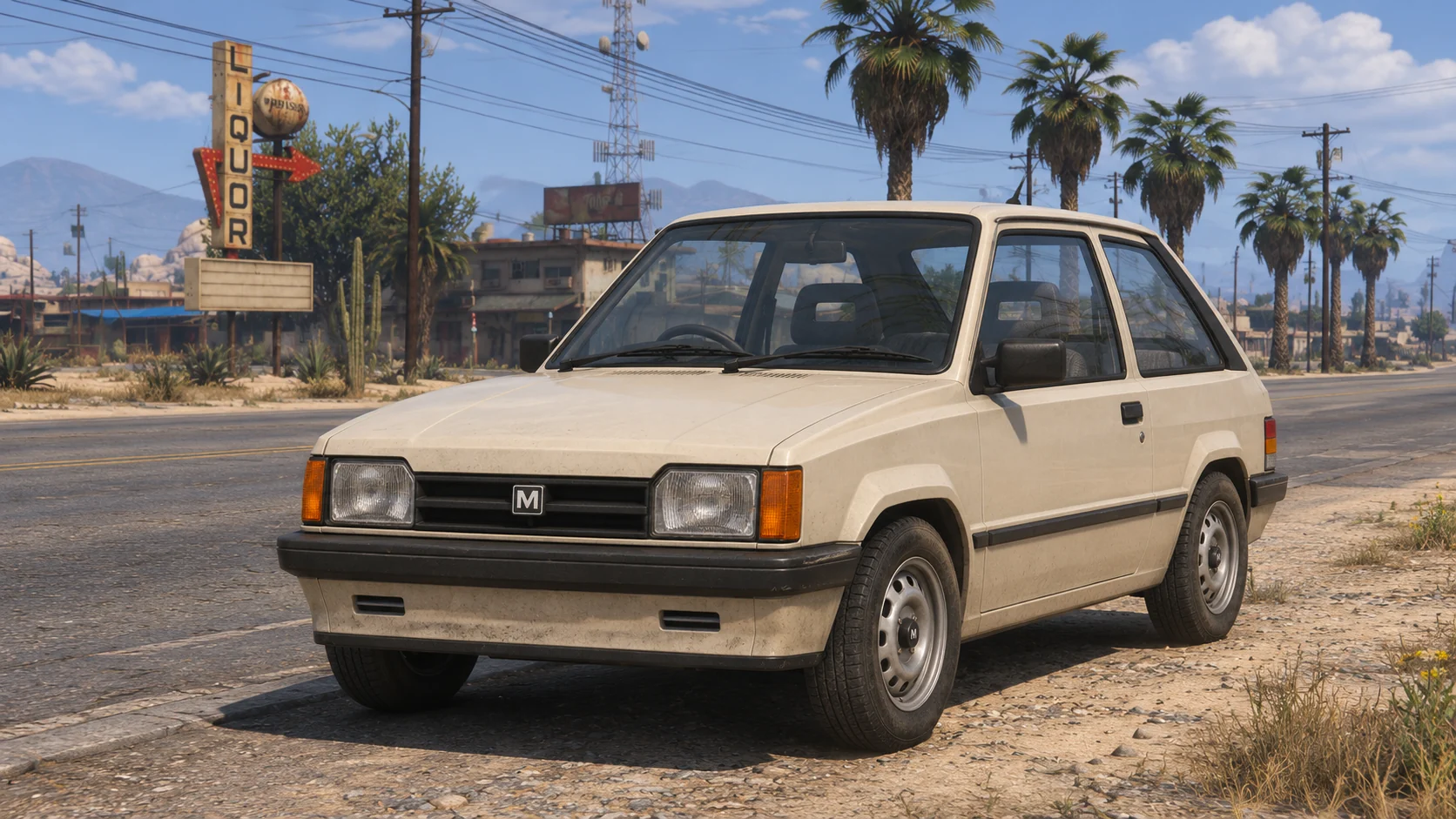
The Maxwell Ruckus is a small, front-wheel-drive car introduced in 1982. Its upright three-door body, simple mechanical layout and modest running costs made it Maxwell’s entry into the compact-car market. A two-seat panel van shared the hatchback’s body shell and became a familiar vehicle for independent tradespeople.
In Los Santos, the Ruckus found buyers who needed a car small enough for a crowded street but practical enough for the journey into Blaine County. It was replaced by the first Asbo in 1993, although inexpensive used examples remained in daily service long after the name disappeared from new-car advertisements.
Development and introduction
Development began at the end of the 1970s, when Maxwell’s Los Santos operation needed an alternative to the large saloons dominating its used-car forecourts. The brief favoured low weight, a short bonnet and a useful rear hatch rather than a reduced version of a luxury car. Engineers placed the engine across the front of the body to leave more space for passengers.
The first local production cars left the La Mesa works in autumn 1982. Dealers concentrated on practical features: replaceable bumper sections, an uncomplicated dashboard and a rear seat that folded to extend the luggage area. Early advertising showed the Ruckus outside small businesses rather than on the grand driveways of Vinewood.
Design and bodywork
The original Ruckus has flat body sides, a steep rear hatch and narrow roof pillars. Rectangular headlamps flank a slim black grille carrying a square Maxwell emblem. Unpainted bumpers and a continuous side rubbing strip protect the painted panels from minor parking damage. Small steel wheels and a high tyre sidewall are characteristic of ordinary road cars.
The interior follows the same restrained approach. Cloth seats, a narrow instrument binnacle and large, simple switches were used across the range. Later cars gained revised upholstery and improved ventilation; the body’s angular outline remained unchanged. Passenger cars retained glazing behind the front doors, while the van replaced it with pressed metal panels.
Engines and transmissions
All engines were mounted transversely and drove the front wheels. The smallest petrol unit suited short urban journeys, while the 1.4 offered more reserve for the gradients outside Los Santos. The diesel was aimed primarily at drivers covering regular delivery routes.
| Engine | Fuel | Output | Gearbox | Typical application |
|---|---|---|---|---|
| 1.0 M10 | Petrol | 45 hp | 4-speed manual | Entry hatchback |
| 1.2 M12 | Petrol | 55 hp | 4-speed manual | Everyday hatchback / panel van |
| 1.4 M14 | Petrol | 75 hp | 5-speed manual | Touring hatchback |
| 1.5 D15 | Diesel | 50 hp | 5-speed manual | Economy panel van |
These were unhurried cars. Short gearing helped them pull away with passengers or tools aboard, but motorway refinement was limited. Owners generally valued the ease of servicing more than outright speed.
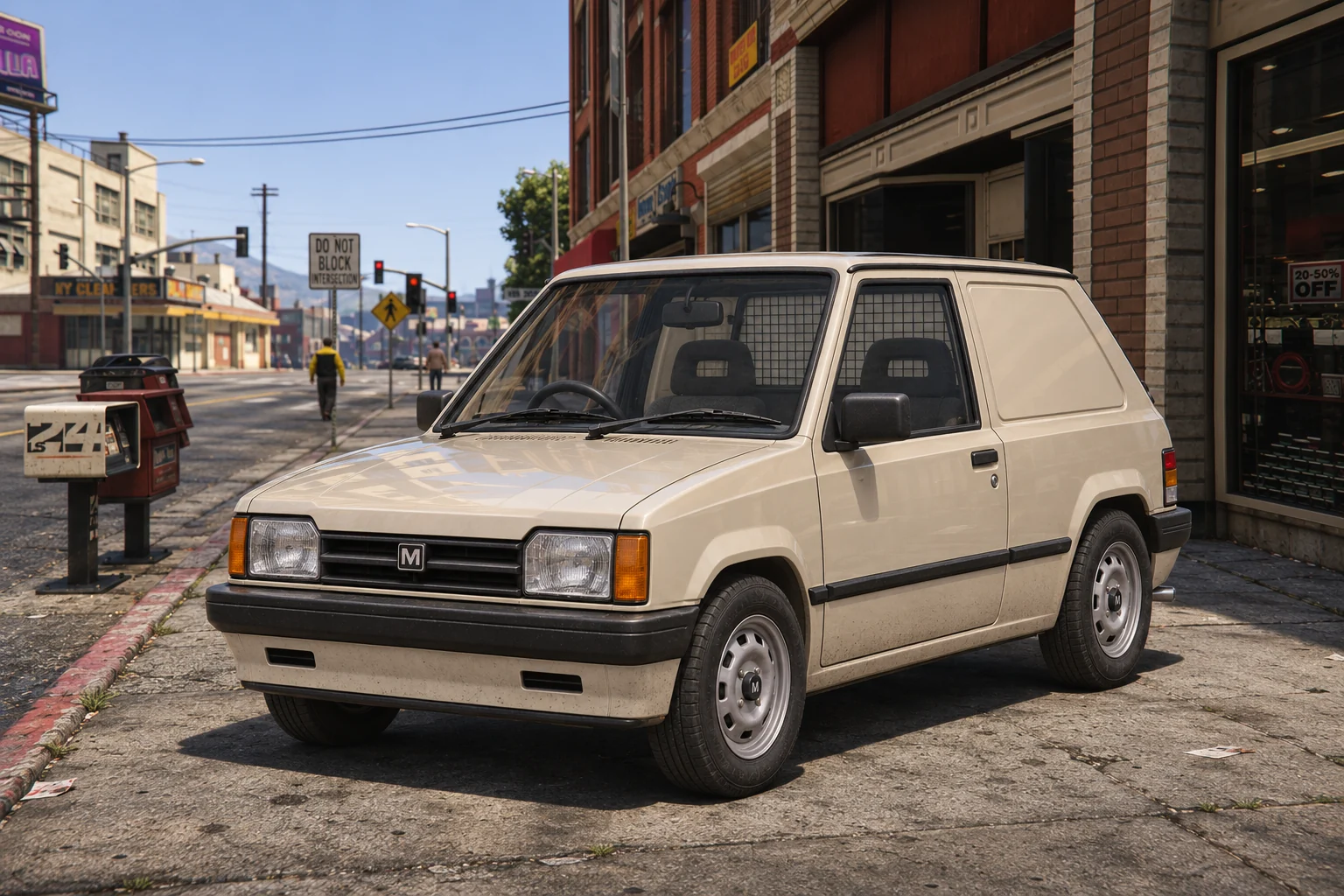
Ruckus Panel Van
The Panel Van joined the range in 1984. It retained the hatchback’s wheelbase, low roof and upward-opening rear hatch, with the rear bench removed in favour of a flat load floor. A mesh bulkhead separated the two front seats from the cargo area. Unlike the later Asbo vans, it had no raised box body or extended rear section.
Its compact footprint suited locksmiths, repair shops and small retailers working between La Mesa, Davis and Strawberry. It could carry tools and parcels without occupying the space of a full-sized van. The simple conversion also made replacement exterior panels easy to obtain. Diesel examples became especially valued by businesses making frequent short stops.
Revisions and equipment
A 1987 revision brought a new seat fabric, quieter engine mounts and a five-speed option for more of the range. A further update in 1990 improved corrosion protection around the sills and rear hatch, while keeping the familiar rectangular lamps and black bumpers.
Trim levels remained straightforward. The base car prioritised price, the City added comfort equipment, and the Touring paired the larger petrol engine with a better-finished cabin. Commercial buyers could specify a passenger-side mirror, a load-area liner and additional tie-down points. None of these changes altered the van’s low-roof body.
Service life and legacy
By the early 1990s, the Ruckus was increasingly out of step with the smoother shapes on Los Santos forecourts. Its replacement would retain the same front-drive principle but adopt the Asbo name. Production ended in 1993 as the new car entered the La Mesa assembly line.
Surviving examples became inexpensive first cars and second vehicles on rural properties. Enthusiasts later began preserving the early square-front cars, especially those still wearing their original steel wheels and unpainted trim. The Panel Van developed a smaller following because many working examples had been used until repair was no longer economical.
Gallery
Select an image to view the full illustration.
Editorial notes
This is DSG Network’s fictional Maxwell family history. The Ruckus, the earlier Asbo, the production chronology, factory history, engine families and commercial derivatives are original additions to this universe. The existing Asbo hatchback provides the established starting point; the extended history is not presented as an official vehicle catalogue.
Vehicle illustrations were created from supplied design references and GTA environment images. They are staged illustrations, not evidence of an official release or an unmodified gameplay capture. The articles cover only the three generations in this collection.
Canon reference: Rockstar Games — The Diamond Casino Heist, which introduced the Maxwell Asbo. No fictional brochure, road test or manufacturer document is cited as a real source.